When I was little I loved to lay under my christmas tree. It was beautiful, seeing the lights through glass bulbs, and the colors of the ornaments, from inside the tree. I felt safe and warm and giddy, with the velvet skirt under my head. I used to imagine what it would be like to be a gift; I'm not sure now what that would even imply, but I remember having thought about it.
Recently I learned a little about the myth of Yggdrasil. For the Norse, winters were long and harsh, so much so that their end times myth centered around the idea of a winter without end for three years straight, bad enough that the forces of the universe, their gods, would begin to freeze to death, and eat each other, and other crazy, confusing things. In the midst of this, there is a tree called the tree of life, named Yggdrasil. Its a huge ash, with three roots, that go through the three worlds. Yggdrasil will last through the end times, and within it two peope, the last man and the last woman, will be safely hidden, until the new world comes out of the sea, bright and new.
The idea of an evergreen being the only survivor through the winter from hell makes sense; the green reminds us that not everything is dead in the middle of January. In comes the ritual of the yule log, and bringing evergreen trees into the house during the winter months. Interestingly, some scholars believe that this is where the Germans got the tradition of burying the dead in pine caskets; they hoped that their loved ones would be hidden from death in the heart of the trees.
In Nordic mythology, one of their greatest gods, Odin, hung from Yggdrasil for nine days, "sacraficing himself to himself", with a spear wound, in order to obtain reason for the world. My Jesus hung from a cross for six hours, sacraficing himself to his father, with whom he was and is one, and then was wounded with a spear in his side, in order to redeem the world.
Christains lament the pagan roots of the Christmas tree tradition every December, but I think that is silly. Ancient longings that were fufilled in Jesus, like the need of a tree where you can hide from death, just prove that we were made for a relationship with Jesus.
I can't wait for my nephew, Liam, to start growing up. We'll lay together under our Christmas tree, and choose our favourite ornament, and talk about all the presents we want, and I'll whisper stories about a baby boy who would take on the sins of the world. Until then, you might find me under there by myself, thinking about what it means to be hidden with Christ in God, and looking forward to the things that happen in Revelation, when we will stand together and defy death as we sing.
Friday, November 23, 2012

Sunday, July 15, 2012
The dust
sparks in
the wind,
a hundred specks.
And I wonder;
how you knew,
from the beginning,
What I was
meant to become.
That one, a tiny part,
a particle, in the make-up
of a beautiful daughter,
an adulterous wife, a prodigal son.
But with that one, I will bring them home.
"I knit you together in your mother's womb."
And the story started long, long before.
sparks in
the wind,
a hundred specks.
And I wonder;
how you knew,
from the beginning,
What I was
meant to become.
That one, a tiny part,
a particle, in the make-up
of a beautiful daughter,
an adulterous wife, a prodigal son.
But with that one, I will bring them home.
"I knit you together in your mother's womb."
And the story started long, long before.
Thursday, May 17, 2012
A couple of weeks ago, me and one of my best friends (and student), Mary, went to Starbucks to talk about Hosea 2. It is one of my favourite passages in the whole bible. It you haven't ever read it, you should; it's like if God were to re-write the story of the prodigal son specifically for girls. Anyways, me and Mary talked about the story, and how it was not about Gomer, but about us, Israel, the bride of Christ. At the end of the conversation, Mary didn't understand the whole of it, and remembered even less. One thing she did remember, and these were her own words, not something I had said, were beautifully reminiscent of verse 16. She said that God isn't supposed to be our master, but our husband. Afterwards, we rocked out to Holy (Wedding Day). It was grand.
For me, the story of Hosea 2 is inextricably tied up with the story of Beauty and the Beast. To explain the depth of my love of fairy tales would take several posts, but, suffice to say, I love seeing the Gospel in stories that mean something to people, especially fairy tales, especially Beauty and the Beast (if you have the time, I strongly suggest everyone read this version, its great.)
For the past week, a question has been in the back of my mind. First, I have to tell you a little about the most famous, early version of Beauty and the Beast. In it, Beauty goes to the beast in her father's place, like in the movie we know. Beauty goes, expecting that the Beast will eat her. Instead, she finds a wonderful life at the castle. Every evening, the Beast asks the same question:
Every evening after supper the Beast came to see her, and always before saying good-night asked her in his terrible voice:
"Beauty, will you marry me?"
And it seemed to Beauty, now she understood him better, that when she said, "No, Beast," he went away quite sad.
And there is the question. "Kelsey, will you marry me?" Am I like Beauty, becoming a willing servant for the sake of other people, being friends with Jesus, talking to him only at meals, but still saying no to him every night? Do I live like Jesus is my husband, or my master? Like he is the lover of my soul or someone who I happen to live with? Do I enter the presence of the Lord out of duty or because I want to be there?
I want to answer yes...
She answered softly, "Yes, dear Beast."
As she spoke a blaze of light sprang up before the windows of the palace; fireworks crackled and guns banged, and across the avenue of orange trees, in letters all made of fire-flies, was written: "Long live the Prince and his Bride."
Turning to ask the Beast what it could all mean, Beauty found that he had disappeared, and in his place stood her long-loved Prince!
For me, the story of Hosea 2 is inextricably tied up with the story of Beauty and the Beast. To explain the depth of my love of fairy tales would take several posts, but, suffice to say, I love seeing the Gospel in stories that mean something to people, especially fairy tales, especially Beauty and the Beast (if you have the time, I strongly suggest everyone read this version, its great.)
For the past week, a question has been in the back of my mind. First, I have to tell you a little about the most famous, early version of Beauty and the Beast. In it, Beauty goes to the beast in her father's place, like in the movie we know. Beauty goes, expecting that the Beast will eat her. Instead, she finds a wonderful life at the castle. Every evening, the Beast asks the same question:
Every evening after supper the Beast came to see her, and always before saying good-night asked her in his terrible voice:
"Beauty, will you marry me?"
And it seemed to Beauty, now she understood him better, that when she said, "No, Beast," he went away quite sad.
And there is the question. "Kelsey, will you marry me?" Am I like Beauty, becoming a willing servant for the sake of other people, being friends with Jesus, talking to him only at meals, but still saying no to him every night? Do I live like Jesus is my husband, or my master? Like he is the lover of my soul or someone who I happen to live with? Do I enter the presence of the Lord out of duty or because I want to be there?
I want to answer yes...
She answered softly, "Yes, dear Beast."
As she spoke a blaze of light sprang up before the windows of the palace; fireworks crackled and guns banged, and across the avenue of orange trees, in letters all made of fire-flies, was written: "Long live the Prince and his Bride."
Turning to ask the Beast what it could all mean, Beauty found that he had disappeared, and in his place stood her long-loved Prince!
Wednesday, March 21, 2012
"Saved to Save"
A flower that stops short at its flowering misses its purpose.
We were created for more than our own spiritual development; reproduction, not mere development, is the goal of matured being--reproduction in other lives. There is a tendency in some characters, running parallel to the high cultivation that spends its whole energy on the production of bloom at the expense of seed. The flowers that are bent on perfecting themselves, by becoming double, end in barrenness, and a like barrenness comes to the soul whose interests are all concentrated upon its own spiritual well-being, heedless of the needs around. The true, ideal flower is the one that uses its gifts as means to an end; the brightness and sweetness are not for its own glory; they are but to attract the bees and butterflies that will fertilise and make it fruitful. All may go when the work is done--"it is more blessed to give than to receive."
And we ourselves are "saved to save"--we are made to give--to let everything go if only we may have more to give. The pebble takes in all the rays of light that fall on it, but the diamond flashes them out again: every little facet is a means, not simply of drinking more in, but of giving more out. The unearthly loveliness of the opal arises from the same process, carried on within the stone: the microscope shows it to be shattered through and through with numberless fissures that catch and refract and radiate every ray that they can seize.
Yes, there lies before us a beautiful possible life--one that shall have a passion for giving: that shall be poured forth to God--spent out for man: that shall be consecrated "for the hardest work and the darkest sinners."
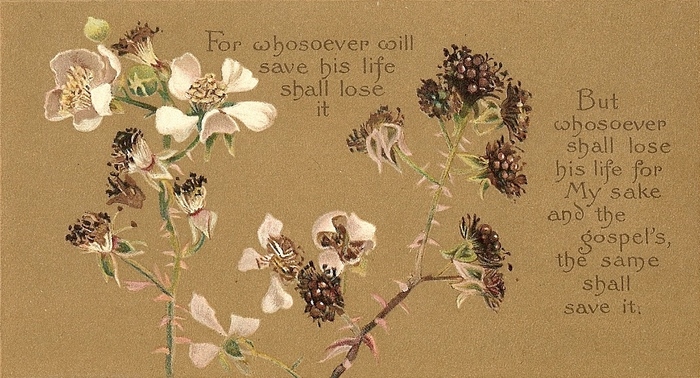
We were created for more than our own spiritual development; reproduction, not mere development, is the goal of matured being--reproduction in other lives. There is a tendency in some characters, running parallel to the high cultivation that spends its whole energy on the production of bloom at the expense of seed. The flowers that are bent on perfecting themselves, by becoming double, end in barrenness, and a like barrenness comes to the soul whose interests are all concentrated upon its own spiritual well-being, heedless of the needs around. The true, ideal flower is the one that uses its gifts as means to an end; the brightness and sweetness are not for its own glory; they are but to attract the bees and butterflies that will fertilise and make it fruitful. All may go when the work is done--"it is more blessed to give than to receive."
And we ourselves are "saved to save"--we are made to give--to let everything go if only we may have more to give. The pebble takes in all the rays of light that fall on it, but the diamond flashes them out again: every little facet is a means, not simply of drinking more in, but of giving more out. The unearthly loveliness of the opal arises from the same process, carried on within the stone: the microscope shows it to be shattered through and through with numberless fissures that catch and refract and radiate every ray that they can seize.
Yes, there lies before us a beautiful possible life--one that shall have a passion for giving: that shall be poured forth to God--spent out for man: that shall be consecrated "for the hardest work and the darkest sinners."
--Parables of the Cross Lilias Trotter
To say that I love that book is an understatement. I just read it over again, and every time I am amazed by her ability to lay out awesome truths about salvation, sanctification, surrender, and ministry in such a short little book. Every time, I come back to that part...
Saturday, March 17, 2012
So, I read this quote a month or two ago, and it's been in my mind ever since:
The place God calls you to is where your deep gladness and the world's deep hunger meet.
I love the idea of this; that we are to reach the deepest, darkest, most forlorn of places for Christ, but beautifuly, and mysteriously, God has formed out hearts in such a way that in doing so we find joy.
I really believe that every meaningful thing that has ever been done for the sake of the Kingdom had this at heart.
Let us fix our eyes on Jesus, the author and perfecter of our faith, who for the joy set before him endured the cross, scorning its shame, and sat down at the right hand of the throne of God. Hebrews 12:2
The place God calls you to is where your deep gladness and the world's deep hunger meet.
I love the idea of this; that we are to reach the deepest, darkest, most forlorn of places for Christ, but beautifuly, and mysteriously, God has formed out hearts in such a way that in doing so we find joy.
I really believe that every meaningful thing that has ever been done for the sake of the Kingdom had this at heart.
Let us fix our eyes on Jesus, the author and perfecter of our faith, who for the joy set before him endured the cross, scorning its shame, and sat down at the right hand of the throne of God. Hebrews 12:2
Subscribe to:
Comments (Atom)